

A tunable laser allows the user to set one device at multiple different frequencies. The ideal device allows frequencies over a wide tuning range, allows in-operation adjustment, provides high selectivity and has low noise.
Widely tunable lasers (more than 15nm) typically consist out of an active section (the ‘laser’) and a frequency selection section (the ‘filter’) along with a mechanism to control the phase. For most compact widely tunable lasers the ‘filter’ is actually a combination of two filter elements, as most suitable tuning elements, with limited dimensions, have a limited selectivity by themselves.
The Pure Photonics tunable laser is an ECL (External Cavity Laser) device, with a gain-section (the ‘laser’), coupled to an external cavity with respectively filter 1 (part 1 of the ‘filter’), a phase section and a filter 2 (part 2 of the ‘filter’), followed by an end-mirror/isolator (in this case mounted on a PZT, but that is not relevant for the tunable laser operation). In this configuration the gain-section is high-reflectivity coated on one side and anti-reflection coated on the side that couples to the external cavity. The isolator is coated on one side to act as an end-mirror. The device is illustrated in the figure below.
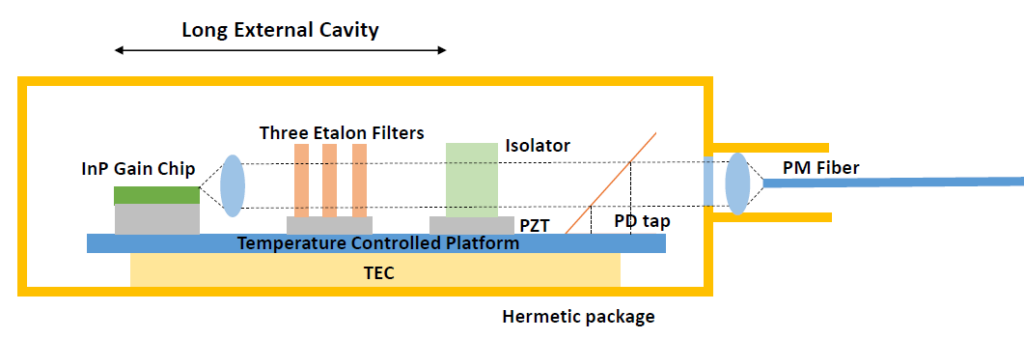
The filter elements and the phase section are thin blocks of Silicon. A heater and an RTD (Resistive Thermal Device) are mounted on each block to increase the temperature (through the heater) an to measure the temperature (through the RTD). Each filter and phase section is thermally isolated from the laser platform and can be individually adjusted. The phase section is anti-reflection coated and by changing its temperature / refractive index the optical length is modified. The filters have been coated with a specific reflectivity to obtain a certain finesse in the filter response.
Each filter has a multi-peak transmission spectrum with a periodicity of about 275GHz (~2 nm). Each filter has a slightly different thickness, so that the peak spacing is different (thicker means a more narrow spacing). Now, if these two filters are placed behind each-other, two peaks can be arranged to align with one another. However, due to the different peak spacing, no other two peaks in the tuning range overlaps. In fact, the design is such chosen that the next peaks that overlap are 70nm away. In this way one peak is selected.
The gain section is generating a fairly wide (~80nm wide) continuous spectrum of spontaneous emission. The filters select only a part of the spectrum and provides high loss for all other frequencies. Due to the nature of laser operation, only certain frequencies (‘modes’) fit within the laser cavity. The only modes that are allowed to laser are within the compound transmission peak of the filter elements. The typically 6GHz spacing between these modes means that several modes fit within the filters’ transmission envelope. The phase section is then used to move these modes around and allows for alignment of one mode with the center of the filter envelope. In that configuration, all other modes have some level of loss and the laser becomes a single-mode laser.
The output light is coupled through a lens in the snout of the hermetically package (‘goldbox’) into the fiber. A tap to a photodiode is present in the output beam to measure the output power from the laser.
In the dither mode, the laser is long-term stabilized and a feedback mechanism is used to align the cavity mode with the filters’ envelope. A sinusoidal signal (at 200Hz) is applied onto the PZT to periodically change the length of the cavity (moving the frequency up and down by 100MHz pk-pk). As the frequency changes, the optical mode traces the transmission characteristics of the filters and the output power reduces a little bit once the mode moves away from the center and increases when it moves towards the center. That can be measured by the photodiode and can be used to modify the phase to get to a target amplitude of that signal. That operating mode is called the dither mode.
In whispermode, the laser has prior been stabilized in the dithermode. After that stabilization the operating conditions are known. So after disabling the dither (voltage on the PZT) the control signals can be fixed and any remaining control loops can be slowed down, resulting in a stable operating laser without excessive dither. This is called the whisper mode. Inherently we would expect the frequency to drift over time in this mode, eventually resulting in loss of lock / modehop. However, we have shown operation in this mode for periods of a week or more.